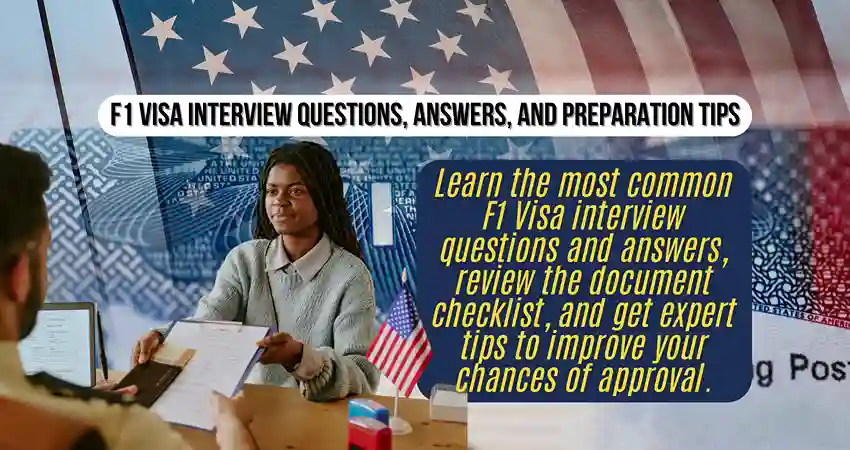
You have been accepted and received an offer letter from a U.S. university. Congratulations! Now, it’s time to prepare for your student visa interview so that you can study in the United States.
If your goal is to study in the United States, then preparing for F-1 visa interview questions and answers will give you the best chance of securing a spot at a college or university.

For international students aspiring to study in the United States, obtaining an F1 student visa is one of the most crucial steps in making your academic dreams a reality. Ultimately, the visa interview determines whether you can begin your studies in the U.S. During the interview, a U.S. consular officer evaluates your academic intent, financial capability, and intention to return home after completing your degree.
There is no shortcut to passing the interview. Like your US university application and the other parts of the visa application process, a successful US visa interview requires preparation.
Table of Contents
ToggleWhat is an F-1 visa?
An F1 visa is a nonimmigrant visa granted to international students who are pursuing a full-time academic program at an accredited U.S. college or university.
It is required for all aspiring international students who wish to study in the US, and obtaining it is the most challenging step in the process. However, success in the visa interview depends on clarity of purpose, financial readiness, and confidence.
How To Dress for an F-1 Visa Interview?
First impressions are always important, so think carefully about what to wear to your US visa interview. The right attire can highlight your professionalism and seriousness. Although there are no written rules about what to wear to a visa interview, there are standard norms and expectations that you should follow. Below are some tips for appropriate interview attire.
- Dress formally — Due to the formal nature of the F-1 visa interview, it is always advisable to choose professional options, and one must maintain dress with seasonal dress-up. During the summer season, consider wearing a light, formal dress.
- Keep accessories to a minimum – Accessorizing heavily can distract your interviewer. Please keep it simple with your jewelry choices. If you have required religious jewelry, wear the bare minimum necessary.
- Choose light fragrances or no fragrance — Many are allergic or sensitive to perfumes or powerful scents. Opt for a neutral or lightly scented perfume and apply it in moderation, or forego a fragrance altogether.
- Ensure you are well-groomed — Grooming and hygiene can be essential factors when preparing for your F-1 visa interview. Keep your nails clean, makeup understated, and hair simple and professional.
Dressing comfortably and presentably will make you feel confident and help you make a good first impression on the interviewer.
In addition to planning your outfit, remember to prepare the necessary documents ahead of time.
Documents Needed for F1 Visa Interview
You must bring the following documents with you to your F-1 visa interview: These documents include:
- You will need the following documents to apply for a student visa:
- An I-20/SEVIS form issued by the U.S. university you plan to attend
- A completed DS-160 visa application form
- Receipts for the visa and SEVIS application fees
- A visa appointment letter
- A passport and a recent passport photo taken within the last six months
- Academic documents, including transcripts, certificates, standardized test scores (e.g., SAT, TOEFL), and diplomas
- Documents proving your financial and personal ties to your home country, as well as proof that you will return after completing your course in the U.S.
- Proof of your relationship with your sponsor (e.g., a birth certificate, information about the sponsor’s employment, and a pay statement), if applicable
- Bank statements and other proof of finances
You must present these documents to the consular officer for evaluation during your visa interview, so it is best to prepare them in advance to make the experience smoother and less stressful. Having your documents in advance also gives you more time to prepare for interview questions.
Common F1 Visa Interview Questions and Answers
Why do you want to study in the United States?
Explain your interest in the high-quality education, research facilities, and global exposure that U.S. universities offer. Note that the U.S. academic system encourages innovation, flexibility, and practical learning, which are features that are not commonly available in your home country.
Why did you choose this specific university?
Be specific about your research. Mention faculty expertise, course structure, industry connections, and placement support. You may also want to highlight rankings or recommendations. Don’t provide general information about your chosen university. Always give the most personalized answer possible. Highlight any achievements personalized to your chosen course. For example, XYZ University is ranked 8th in business administration in the state. This highlights the quality of the business administration program at this university. You can also highlight the department’s alumni and other personalized information. This will help you avoid common answers and create a unique one. Common answers can cause a visa rejection. The US Embassy consular officer asks very few questions and gives less time for each answer. Each answer increases the chance of visa approval and the chance to answer more questions. The consular officer could approve your visa after the first two or three questions or reject it after the first question if they are not satisfied. Therefore, you must prepare the best personalized answers for every possible question from the US Embassy.
Which program will you study, and why?
Connect your academic background and career aspirations to your chosen program. Emphasize how it fits into your long-term goals. You can even relate it to something from your home country. For example, I intend to work at X, Y, or Z Company here as a marketing [position], but I require further qualifications. Or, I have my parents’ business and need to expand it, for which I require an extended qualification and understanding of business and the market.
Why not study in your home country?
Avoid criticizing the local education system. Instead, emphasize what makes U.S. education valuable, such as advanced research, international exposure, and modern technology. You can mention that you can learn from talented, world-renowned professors in your department. You can also receive personalized counseling from them, as USA universities have small class sizes.
Financial-Related F1 Visa Questions
The visa officer must be convinced that you have the financial means to fund your education and living expenses in the U.S. without working illegally. You must also demonstrate that you will not resort to crime to finance your studies. Therefore, you must prepare a strong case regarding your sponsorship.
Who is sponsoring your education?
Clearly state who your sponsor is (parents, relatives, or yourself) and what they do for a living. You should be familiar with their income, source of funds, and ability to support your studies. Establish a close relationship with them.
How will you pay for your studies?
Provide a complete breakdown of tuition fees, living expenses, and your source of funding (bank savings, scholarships, or loans). Make sure your documents match your verbal answers. Also, mention how your sponsor will send the tuition fees after you arrive. For example, via bank transfer.
Can you show proof of financial capacity?
Be ready with bank statements, affidavit of support, loan approval letters, and scholarship documents. Present only if requested, but mention that they are prepared.
F1 Visa Questions Regarding Intent to Return Home
The most important part of your F1 visa interview is demonstrating that you intend to return home after completing your studies. The officer must believe that you have no intention of overstaying your visa. You are not a likely immigrant. To prove that you are not an expected immigrant, you must provide a valid explanation of your goals and plans after graduation.
What are your plans after graduation?
Clearly outline your plans for after you finish your studies in your home country. Describe any career opportunities, business ideas, or family responsibilities awaiting you. Provide examples of large companies in your country and explain your intention to work with them. Alternatively, you can discuss your intention to expand your family business internationally.
How can you prove that you will return home?
Mention family ties, property ownership, career prospects, or business commitments that will ensure your return. Also mention that you need to take care of your parents or their business if you are an only child or if your siblings are already involved in the family business.
Personal and family background questions for F-1 visa interviews
These questions help officers understand your background and motivations. The officer can also judge whether you will return to your home country after graduation or remain there as an immigrant. For example, if you have a sister who is already in the USA and has claimed asylum or broken immigration laws. This could cause your visa to be rejected because the officer will think you are a possible immigrant who might violate USA F1 visa regulations.
What do your parents do?
Give a clear, concise answer – “My father is a businessman in the furniture industry, and my mother manages our family business operations.” All questions should be related and linked well with an explanation.
Do you have relatives in the U.S.?
Always answer truthfully. The officer already has access to this information.
Have you visited the U.S. before?
Answer honestly and mention the purpose of your trip, e.g., tourism or conferences.
Here are other questions that asked before
- How many universities did you apply to?
- How many offer letter did you received?
- Why don't you consider XYZ University for your final choice?
- Do you know any professors at that university? What are their names?
- In which city is your university located?
- How much do you know about the local area?
- What are your test scores? (GRE, GMAT, SAT, TOEFL, or IELTS.)
- What was your previous GPA?
- How will you handle the cultural and educational differences in the United States?
- Why not study in Canada, Australia or the UK?
- How did you find out about your university?
- Mention the names of the faculty at the university where you will study.
- Can you tell me about the city where your university is located?
- Did anyone help you research these universities?
- Did you take any help from an educational consultancy?
- How many I-20s did you get?
- Do you want to work part-time there?
- How will this degree help you in the future?
- Why would you come back when you received a job offer from a big company based in the USA?
- What is an I-20?
- What is SEVIS?
- How many siblings do you have?
- Is it worth spending this much money on this degree?
- What would make you want to come back to your country?
- Why should I grant you a visa?
- What if your visa isn't approved?
- Will you work while you study?
- How do you plan to repay the money you spent on this course?
- Will you come back to your family during the summer?
- Did you speak or communicate with any faculty related to your course?
- Will you stay off campus or on campus?
Tips for a Successful F-1 Visa Interview
- Be honest and confident – Answer every question truthfully. Being confident and clear shows that you are genuine.
- Be concise and specific – Avoid memorised or lengthy answers. Speak naturally and stay on point.
- Be Consistent – Ensure your answers align with your DS-160 form, I-20 details, and financial documents.
- Know Your Course and University – Be familiar with your program’s modules and professors, as well as the reasons you chose this institution. Also, learn about your department’s achievements.
- Prepare Your Story – Demonstrate the logical progression of your academic and career journey. Explain why you chose your program, how it aligns with your future goals, and why you plan to return home.
Common Mistakes to Avoid in F-1 Visa Interviews
- Inconsistent answers between your documents and responses.
- Lack of knowledge about your university or course.
- Weak explanation of financial support.
- Expression of interest in staying permanently in the U.S.
- Nervousness or lack of confidence during the interview.
The F1 visa interview is your opportunity to prove that you are a serious student with the financial means to study abroad and return home after graduation. Since the interview is short, you must prepare yourself properly for each question. Each answer will determine whether or not you will receive the visa.
Know your documents, understand your program, and communicate confidently.
If you need help preparing for your visa interview or crafting a strong statement of purpose (SOP), reach out to STS Global Education.
Our experienced counsellors provide personalised visa guidance, mock interview sessions, and document reviews to help you succeed.